
Built by Experts in Tokyo
Master Japanese.
Pass JLPT.
The all-in-one platform for serious JLPT learners. Practice with 34,000+ authentic questions, take full-length mock tests, have real conversations with AI, and get personalized coaching — all in one place.



34,000+
JLPT Questions
100
Mock Tests
N5–N1
All Levels
8
Languages
How It Works
Start learning in 30 seconds
Choose Your Level
Select your JLPT level from N5 (beginner) to N1 (advanced). Change it anytime as you progress.
Study Your Way
Drill vocabulary and grammar, take mock tests, practice conversations, or read daily articles.
Track & Improve
Your AI Coach analyzes your performance and tells you exactly what to focus on. Watch your accuracy grow.
Features
Everything you need to pass JLPT
Six powerful tools working together. Practice, test, speak, read, review, and get coached — the complete learning system.
JLPT Drill Practice
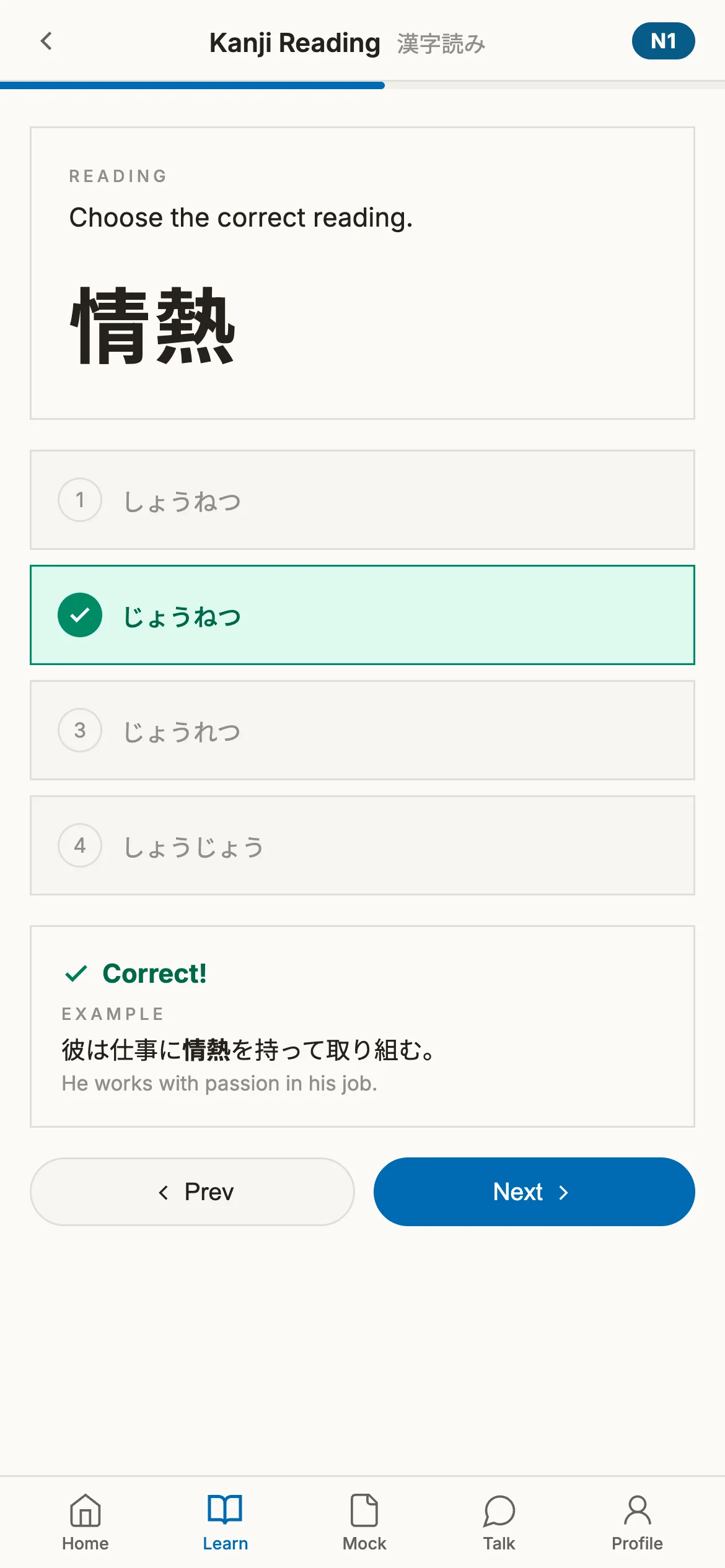
25,000+ questions across vocabulary, kanji, and grammar. Multiple skill types: meaning, reading, writing, reverse translation, and sentence completion. Every question in authentic JLPT format.
25,000+ questions
Full-Length Mock Tests
100 complete JLPT mock tests with 9,300+ questions. Exam mode with real time limits or practice mode at your own pace. HD audio for all listening sections.
100 mock tests
AI Conversation Practice
Practice real Japanese conversations with AI characters. 6 scenarios from self-introductions to free talk, each with 5 realistic situations. Voice input with speech recognition.
30 conversations
Daily Reading
A fresh Japanese article every day, matched to your JLPT level. Read with furigana support, toggle translations, and test comprehension with quiz questions.
New every day
AI Learning Coach
Your personal AI tutor analyzes your strengths, weaknesses, and study patterns. Get specific guidance on what to focus on next to improve fastest.
Personalized
Spaced Repetition
Built-in SRS automatically schedules reviews at optimal intervals. Track your mistakes and practice them until mastered. Never forget what you learned.
Smart review
Result-Driven Learning
Every test makes you smarter
Practice is just the start. Fujisan.AI turns every Mock Test into clear feedback, a personalized study plan, and an AI Coach that adapts to your real exam performance.
See exactly where you stand
Get instant scoring and clear pass/fail status against the threshold for every Mock Test, with a section-by-section breakdown across vocabulary, grammar, and listening.
Instant scoring
Know what to study next
Weak in vocabulary? Listening? Get specific recommendations linking straight to the right drills, daily reading, or a session with your AI Coach.
Personalized next steps
Your AI Coach learns with you
Your latest Mock Test results help shape your AI Coach, so its weekly focus and study tips reflect your real exam performance — not just what you've drilled.
Mock-aware coaching
Built for Serious Learners
More than just a question bank
HD Listening Audio
Professional Japanese voice actors for all listening sections. Natural speech at authentic JLPT speed.
Voice Input
Practice speaking with speech-to-text recognition. Talk to AI characters using your voice.
8 Languages
Interface and explanations in English, Korean, Vietnamese, Chinese, Spanish, Portuguese, and Indonesian.
Progress Tracking
Weekly activity charts, accuracy by category, and clear visibility into what you've mastered.
Study Streaks
Build consistency with daily streak tracking. Stay motivated and make learning a habit.
Expert-Curated Content
Every question reviewed by native Japanese speakers. Authentic JLPT format you can trust.
Pricing
One plan. Full access. No limits.
7 days free. Cancel anytime.
A subscription (with a 7-day free trial) is required to use the app.
Available plans
- Unlimited drills, mock tests, conversations
- AI Learning Coach with personalized guidance
- HD audio for all listening sections
- Spaced repetition & mistake tracking
- Daily reading with translation
- Voice input for conversation practice
FAQ
Frequently Asked Questions
Ready to master Japanese?
Join thousands of learners preparing for JLPT with Fujisan.AI. Start your free trial today.